How it works
The design record that becomes your submission.
Requirements, risks and test evidence live in one linked record. Allele plans your FDA pathway, shortlists your predicate and assembles the 510(k) package from that record, and no AI draft counts until a person verifies it.
Guided, not outsourced.
An eQMS keeps your paperwork. It doesn't get you to market.
Startups and consultants end up stitching a document system to a pile of FDA guidance PDFs and a consultant's inbox. The strategy (the part that actually decides whether you get cleared) lives nowhere.
Which pathway?
510(k), De Novo, PMA, or exempt? The wrong call costs months and hundreds of thousands. Most tools stay silent on it.
Which predicate?
Substantial equivalence makes or breaks a 510(k). A document store won't find your predicate or flag its recalls.
Now assemble it
Turning your records into an FDA-format submission is the real work, and it's where an eQMS hands you back a blank template.
Your device's FDA class reshapes the whole workflow.
Pick a class and watch the path change: the same engine that runs inside the product. No generic checklist; the route that actually applies to your device.
- Step 1
Device profile
Set the class: it drives everything
- Step 2
Predicate search
Screened on intended use, recall-flagged
- Step 3
Confirm pathway + Pre-Sub
510(k) chosen on the predicate; questions to FDA
- Step 4
Records
Requirements · Risk · Usability · tests
- Step 5
Compile the 510(k) package
Pulled from your records
- Step 6
You file · we track
CDRH Portal · ~90-day clock
Class II → 510(k): predicate-driven. Show substantial equivalence, prep a Pre-Sub, then assemble the package. You file; FDA goal ~90 days.
510(k) user fee $28,653, or $7,163 for a small businessFDA review goal: 90 FDA days. FY2027 FDA figures, a planning estimate: confirm current fees with FDA.
- Step 1
Device profile
Class III · high risk
- Step 2
Pathway (PMA)
Clinical strategy, not equivalence
- Step 3
Clinical / IDE
Pivotal study is the long pole
- Step 4
Records
Risk · biocompat · manufacturing
- Step 5
Compile PMA
Modules + benefit-risk
- Step 6
You file · we track
CDRH Portal · ~180-day FDA goal
Class III → PMA: evidence-driven. No predicate shortcut: the pivotal clinical study gates the filing. FDA goal ~180 days plus a facility inspection.
PMA user fee $636,732, or $159,183 for a small businessFDA review goal: 180 FDA days, plus a facility inspection. FY2027 FDA figures, a planning estimate: confirm current fees with FDA.
- Step 1
Device profile
Class I · likely exempt
- Step 2
Confirm pathway
Confirm the exemption holds
- Step 3
Registration & listing
Establishment + device (FURLS)
- Step 4
On the market
General controls apply; no 510(k)
Class I → 510(k)-exempt: the shortest path. No premarket submission. Confirm the exemption, then register and list with FDA.
No premarket fee; establishment registration $13,785 a yearNo FDA review: register and list. FY2027 FDA figures, a planning estimate: confirm current fees with FDA.
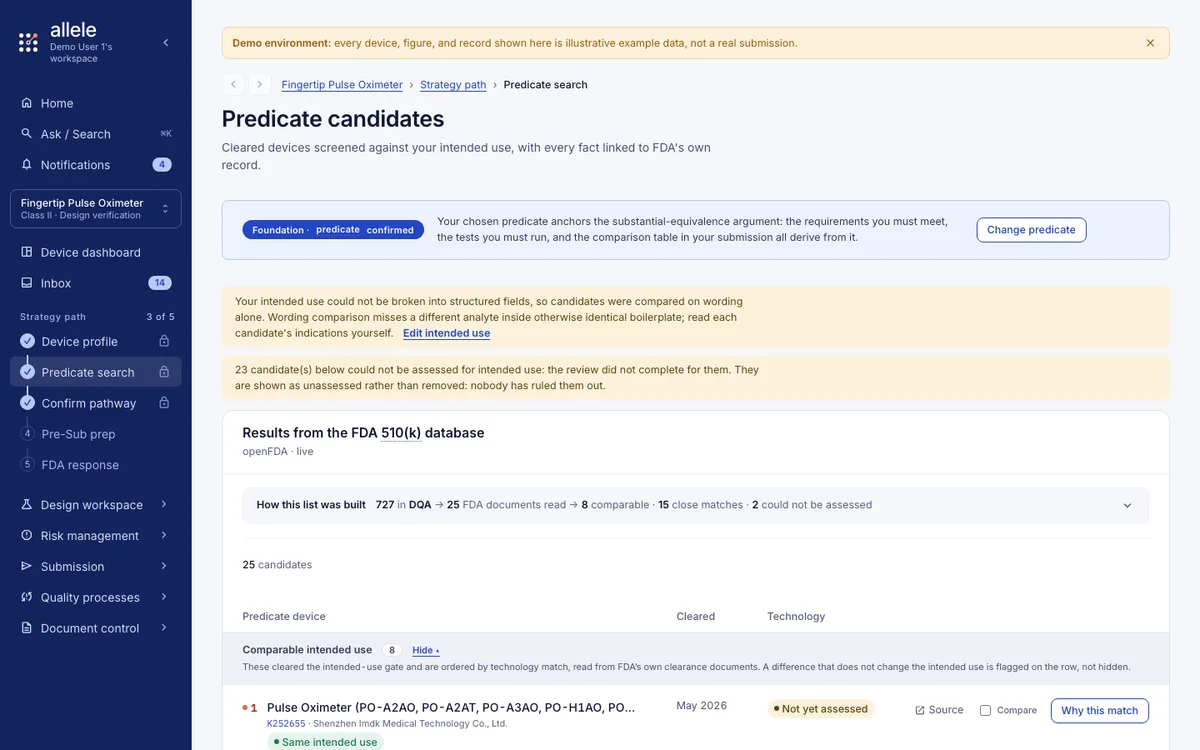
Find your predicate
A vetted predicate shortlist in minutes.
Every candidate is screened against your intended use, ordered so complete devices outrank accessories and then by technology match, flagged for recalls and adverse events, and linked to the exact page and quote in FDA’s clearance summary. You can see and correct how your intended use was read, and name predicates you already know so they’re always assessed.
- “Why this match” reasoning, factor by factor
- Recall / MAUDE safety flags surfaced
- Watch a predicate, product code or applicant: new recalls, adverse-event signals and clearances, checked daily and flagged in the app
- Predicate lineage (what your predicate cited, and who cites it), De Novo decisions in the search, and filters when the list calls for them
Show 4 more
- MAUDE trends and reports, a life-cycle view per product code and a recall browser, from FDA’s public data
- Ask a cleared device’s 510(k) document a question and get its own words with page numbers
- A substantial-equivalence comparison with your predicate, each fact cited to its 510(k) summary (PDF + CSV)
- A citation cross-check across your package (records, FDA decisions, eCFR sections, guidance titles, standard editions), and every fact in the SE comparison labelled confirmed, claimed, inferred or unknown
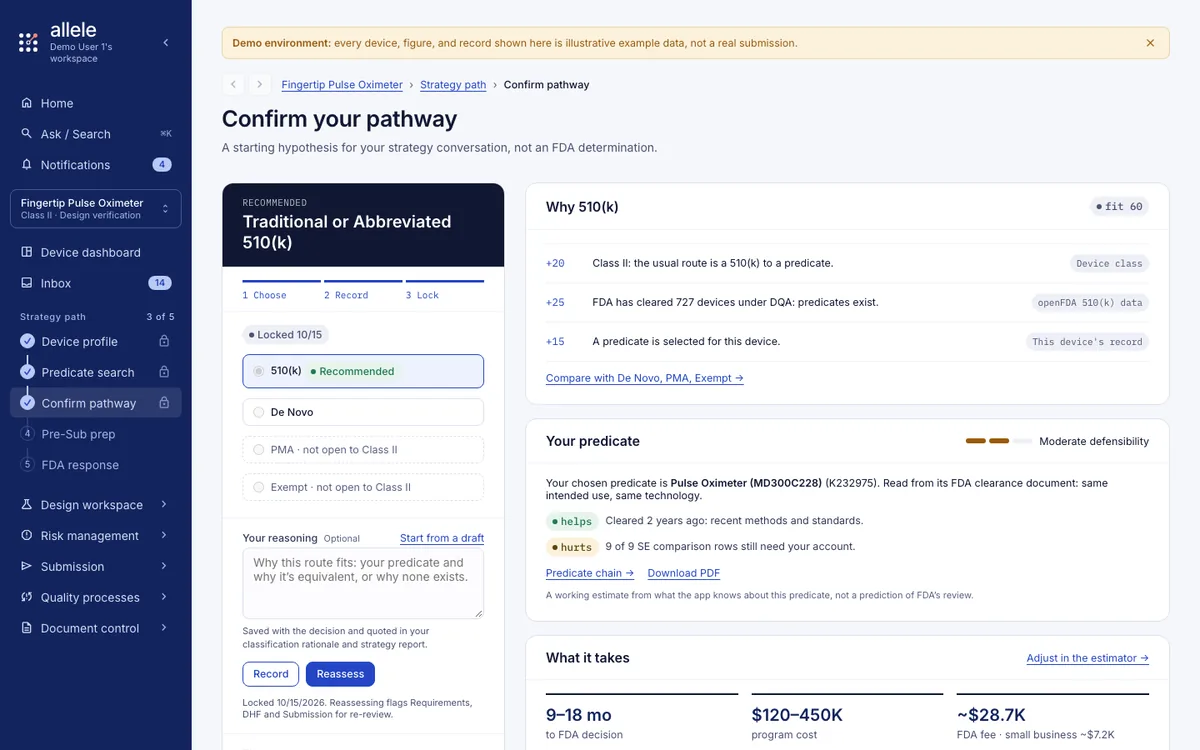
Know your path
See your FDA route before you spend on it.
A class-aware pathway assessment, with a Pre-Submission (Pre-Sub) you can prepare and send yourself.
- Pathways scored from FDA’s records for your product code, every point sourced; how defensible your predicate is; a device-change (letter to file) questionnaire following FDA’s guidance; and a one-file strategy report
- Pre-Sub prep with a question-quality check, questions ranked by how much the answer would change your plan
- AI wording advice on your intended use against the predicate’s indications, and a simulated reviewer’s likely questions tied to your records: opinions you verify, never approval odds
- FDA device guidance tracked daily, new and revised documents flagged where your records cite them, and a weekly FDA digest
Show 3 more
- PubMed literature saved to each device with its PMID, research memos where every claim cites FDA’s records or a saved abstract, and side-by-side strategy scenarios
- A classification rationale PDF to share with investors or clients
- A cost & timeline estimate using current FDA user fees
Prove every answer
AI provenance you can defend.
Every AI-touched passage is tagged and stays "suggested" until a human verifies it. Only verified content counts toward readiness, so you always know what the machine wrote and what you approved.
- Per-line source: you, AI, or verified
- Nothing is "done" until a person signs off
- An audit trail that shows your reasoning
- Exports show each signer’s role at the time they signed
Show 3 more
- Every AI edit shown as a diff before it changes anything; redrafts proposed when a record it traces to changes; a quality score for each submission section, with its reasons
- Ask: answers cited to your own records, or no answer
- Ask a platform expert to sign off a record: they get time-limited, read-only-plus-sign-off access, and their sign-off lives in the record
Intended use matches the cleared predicate's indication.
Proposed substantial-equivalence rationale. Review before it counts.
Low-perfusion limitation flagged for the IFU.
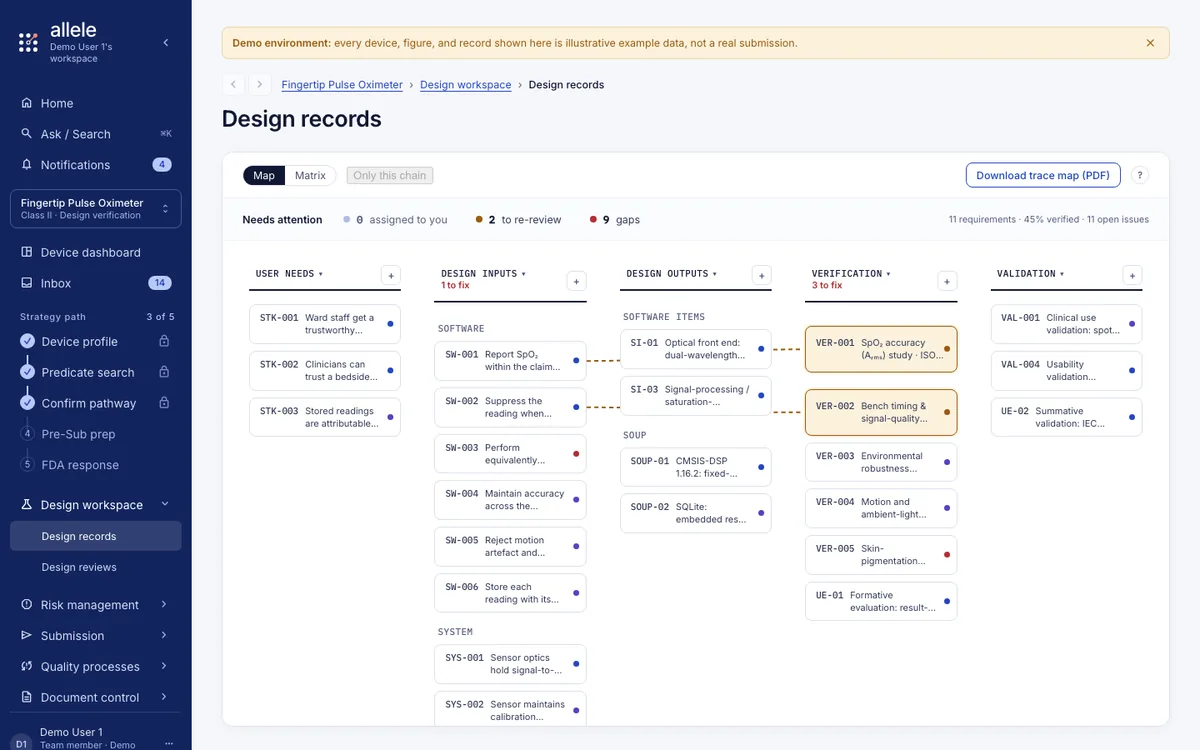
One connected workspace
One connected design record, from user need to DHF.
Every requirement, output, test, risk and usability task lives in one linked record, with every version kept. Traceability isn't a spreadsheet you rebuild before an audit. It's how the work is stored, so it holds up through every change. Already have a requirements spec? Upload the PDF or Word file and the AI pulls out the requirements it states, each with the exact quote and page, for you to tick and verify.
- User needswhat the device must do, for whom
- Design inputssystem & software requirements
- Design outputsarchitecture, components, SOUP
- Verificationtest protocols & logged runs
- Validationusability tests; the pivotal study for PMA
Risk management (ISO 14971): hazards, risks and controls link to the inputs they constrain and the tests that prove them.
The same record feeds the DHF, submission readiness and the QMSR gap check. Fix something once and every view reflects it.
You change a requirement
A new version is saved and everything downstream that was complete is flagged, so nothing silently goes stale.
- TEST-021 · SpO₂ accuracy protocolNeeds re-review
- RISK-004 · over-reads at low perfusionNeeds re-review
You log a passing test run
One action closes the chain: the test, the requirement it verifies and the risk it controls all update together.
- REQ-012 · SpO₂ accuracyVerified
- RISK-004 · over-reads at low perfusionAcceptable, verified
Illustrative example. Record IDs are your own.
Guided risk management
An FMEA-style flow builds the hazard → risk → control chain in one step and derives its status. Your risk plan is kept and locked per device.
Design reviews with phase gates
7 phases for a 510(k), 12 for a PMA. Approval goes through sign-off with a date and attendees, and closing an action item requires evidence.
A DHF compiled from the record
8 elements for a 510(k), 14 for a PMA. Evidence tables are built from your real links, not retyped, then signed off and exported as a PDF binder.
Coverage and sanity checks
See what's verified, what has no completed test, which risks are still unacceptable and what was flagged after a change, ordered by severity.
AI that respects the record
Draft requirements, flag ones that can't be measured and suggest missing links. Every suggestion stays unverified until a person accepts it.
Scoped to your device class
Class II gets the full 510(k) set; Class III adds clinical evidence; a Class I exempt device sees only the minimal records that apply.
- Requirements, software (IEC 62304) and usability (IEC 62366) records in one place
- Bulk import of existing requirements, brought in as unverified drafts
- Traceability matrix export as CSV or PDF, with gaps and flagged items shown, never hidden
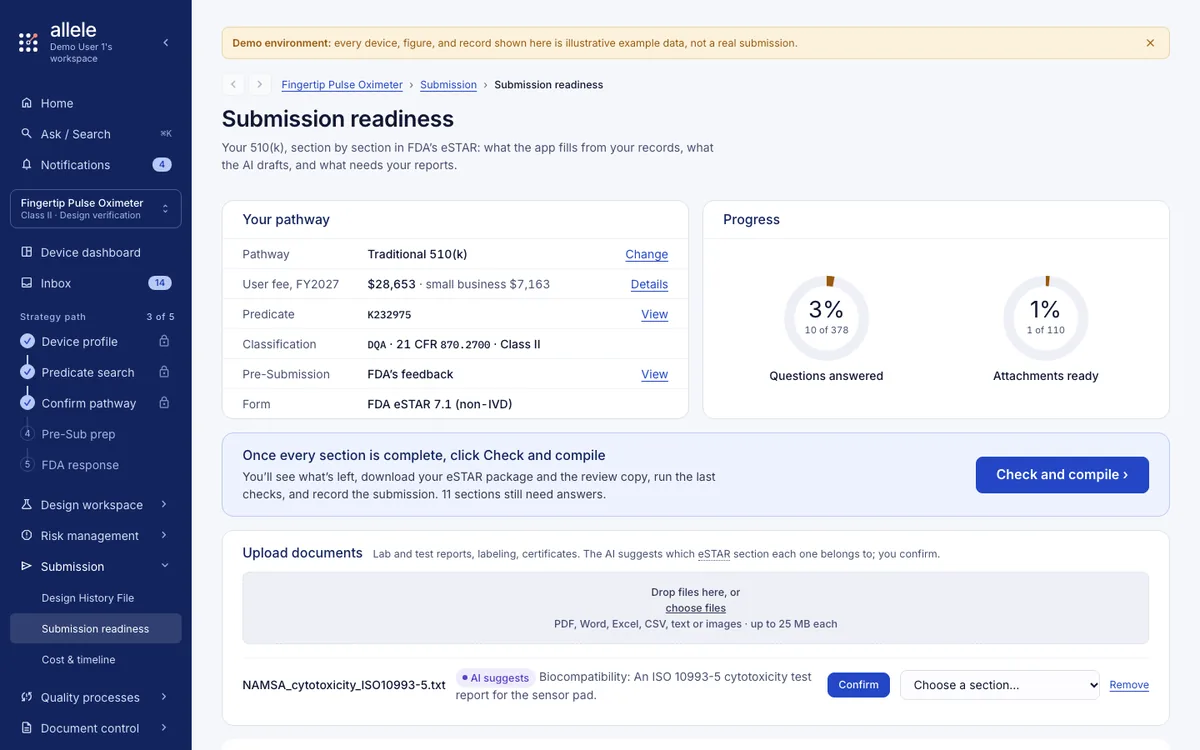
The submission builder
It pulls the sections it can straight from your modules, lets you import or draft the gaps, then assembles the package: the actual cover letter, IFU and comparison, ready to review. Assemble your 510(k) package and track the review. You file with FDA; we keep the record.
- Pulls from Requirements, Risk, Test runs & DHF
- A deterministic package-completeness check before you file (not FDA’s own acceptance screen)
- A cybersecurity section shaped like eSTAR’s: the section 524B cyber-device questions, an SBOM reader (CycloneDX or SPDX JSON) and every attachment eSTAR asks for
- A standards and citations list read from your records, and the whole package as one ZIP with a hash manifest (not an eSTAR)
Show 2 more
- Draft point-by-point answers to an FDA deficiency letter that you review before anything is assembled, and a checklist of the 21 CFR Part 801 elements in your label and IFU
- FDA user fees and a small-business check, with current fees linked from FDA
The full quality system, too
Document control with Part 11-ready sign-off and release control, training with competency quizzes, CAPA with a postmarket loop, complaint/MDR triage, suppliers, and an Audit center that generates auditor spreadsheets and a QMS state report on demand.
- Part 11-ready records & a database-enforced audit trail
- QMSR gap check with a tracked list of FDA regulatory changes
- Unlimited controlled documents & records
- A device Inbox: what’s waiting on each device, most severe first
Show 2 more
- Upload your own SOPs and templates and draft new documents in their style; generate a starter set of SOPs and plans for a device, including the post-market surveillance plan, each a draft you review and release
- Legal holds that block deleting, obsoleting or unlinking what they cover, and retention rules that list records past their period for you to decide on (nothing is ever deleted automatically)
Working together
- Comment on any record, document or submission section, mention colleagues and assign follow-ups with a due date; every thread shows whether the thing it discusses is verified
- Section-level permissions: an owner can limit who may edit or review each submission section, enforced on the server
For consultants
- A personal library of your own templates, SOPs and snippets that you copy into any client workspace, never shared between clients
- One review queue of every AI draft waiting across all your clients; a records-vs-procedure audit that names the clause each finding tests; complaint trends beside MAUDE and your risk file
Built for regulated work.
Built by a device-industry regulatory practitioner, for records you'll have to defend. The controls a quality team and a buyer's security review ask about, with honest status.
- AI you can checkEvery AI passage carries its source and a record of who verified it. Nothing counts as done until a person signs off.In place
- Part 11-ready recordsRe-authentication at signing, and an append-only audit trail the database enforces.In place
- Workspace isolation enforced at the database levelEvery client's records are separate, checked twice. Encrypted in transit, and at rest by the hosting platform.In place
- Role-based access (4 roles, 20 permissions)Plus single sign-on (OpenID Connect), an IP allow-list per workspace, and access you can end.In place
- Design reviews with phase gates7 phases for a 510(k), 12 for a PMA. A DHF compiled from the record: 8 elements for a 510(k), 14 for a PMA.In place
- Your data is yoursWhole-workspace and audit-trail export in standard formats, and a read-only MCP connector for Claude and other AI clients.In place
- A QMS state report on demandIt describes your records, and is not a validation package.In place
- SOC 2 Type II, ISO 27001 and an IQ / OQ / PQ validation packagePlanned ahead of paid pilots. Nothing here is claimed before it is in place.Planned
Status as of October 2026. Read the full trust page
The only tool that spans strategy, submission, and QMS.
Formwork drafts documents cheaply. Greenlight Guru stores them at enterprise scale. Cruxi does submission drafting without the quality system. Allele matches the incumbents on the quality system and does the FDA strategy work in between. It is straight about where it is not there yet.
| Capability | Allele | Formwork | Greenlight Guru | Cruxi |
|---|---|---|---|---|
| ISO 13485 / QMSR document control | ● | ● | ● | — |
| Part 11-ready e-signatures (password re-entry) | ● | ● (claims compliant) | ● | — |
| Risk, software, usability (14971/62304/62366) | ● | ● | ● | — |
| CAPA, complaints/MDR, training, suppliers | ● | ● | ● | — |
| AI drafting and requirement checks | ● | ● | ● | ● (submission drafting) |
| Predicate search with recall flags and FDA sources | ● | — | — | ● |
| AI output linked to exact source page and quote | ● | — | No (asks users to verify) | ● |
| Per-record provenance and human verification status | ● | — | — | — |
| Class-aware pathway strategy (510(k)/PMA/exempt) | ● | — | — | Partial (classification) |
| Pre-Sub prep | ● | — | — | — |
| eSTAR / submission assembly | Readiness by eSTAR section + eSTAR data file (you file) | — | — | ● (18 sections) |
| DHF + live traceability matrix | ● | Partial | ● | — |
| Multi-client consultant workspaces and a cross-client dashboard | ● | — | — | Agency credits |
| Validation report, migration, support | Planned | ● | ● | Optional expert review |
| Clinical evidence (EDC) | — | — | ● | — |
| Price | Founding cohort | Free; $119/mo; $599/mo | ~$15–60K/yr + onboarding | $1,000/submission, $200/service, or $500/mo |
Competitor features and prices verified September 2026 from each vendor’s published pages; confirm current details. Sources: openregulatory.com/formwork/pricing · openregulatory.com/articles/greenlight-guru-price · greenlight.guru/blog/greenlight-guru-ai-features · cruxi.ai predicate-finding, 510k-submission-services and pricing pages.
Questions, answered.
Is this an eQMS or a submission tool?
Does it work for Class I, II, and III devices?
How does the AI stay trustworthy?
Can it actually generate my submission?
Can I get my data out?
Can my client or an outside reviewer see the records?
Can I try anything without an account?
Can I use it from Claude or another AI assistant?
Does it work with Slack or Microsoft Teams?
Does it connect to Jira?
Can I import documents from Google Drive?
Is the tool itself validated?
Who's behind it?
From predicate to cleared, in one workspace.
Bring one device, and see your pathway and submission take shape.